Frame-by-frame object detection, image classification and pose estimation are the native workload here. Networks of the SSD-MobileNet and YOLO family, already quantized to int8 and built for the silicon, come back in milliseconds without the data ever leaving your machine.
Each module draws a handful of watts, so a camera or sensor stream can be scored around the clock while the Xeon behind it runs your actual application. That offload is the whole point of the part: the arithmetic moves, the host stays free.
Neither module can hold a model measured in billions of parameters, quantized or not, and nothing on this page pretends otherwise. Working out what a given model needs is a question for LLM hosting; the discrete cards that answer it are priced on GPU dedicated servers.
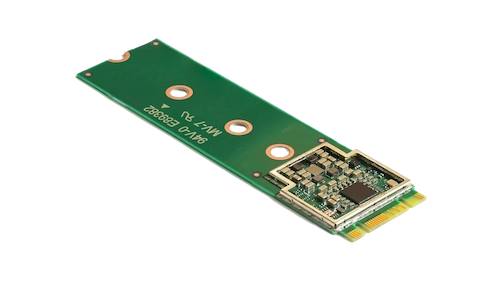
Google rates the Coral’s Edge TPU at 4 TOPS on 8-bit integers, at a power draw of about two watts. That rating is Google’s own, repeated here as published — we have not benchmarked the part ourselves.
What it buys in practice: TensorFlow Lite models, quantized to int8 and passed through the Edge TPU compiler ahead of time, run on the module instead of the processor. A network either compiles for it or it does not — the established vision models do, and that compile step is the real price of admission.
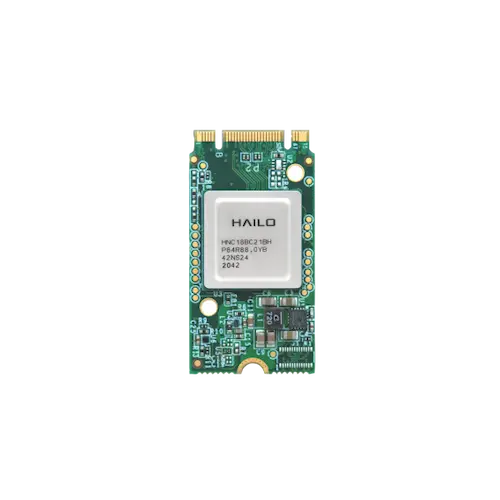
Hailo’s own rating for the Hailo-8 is up to 26 TOPS on 8-bit integers; we repeat the number as the maker publishes it, without a benchmark of our own. It is the stronger of the two options, and the one to tick when a Coral-class network stops being enough.
A network arrives from TensorFlow or ONNX by way of Hailo’s Dataflow Compiler, and the compiled result is served by HailoRT on the operating system you chose. Like the Coral, it accelerates neural networks and nothing else — it is not spare general-purpose compute.

Neither accelerator is a product of its own. Each is one option line on a cartridge’s configurator, priced there next to the machine that carries it — no figure is typed on this page, because the order form holds the current one.
The slot rides HPE Moonshot hardware: the m710x on a quad-core Xeon E3-1585L v5, or the m510 on Xeon D — eight cores as the D-1548, sixteen as the D-1587. Choose the host first, then add the module to it.
Single-tenant bare metal with root. The vendor stack — the Edge TPU runtime for the Coral, HailoRT for the Hailo-8 — is installed by you, on your OS, at versions you pin. Nothing updates the machine behind your back.
The step past an M.2 module is a discrete card, not two modules. Every card we rack is listed with its machine on GPU dedicated servers; more than one card — or more than one machine — is HPC territory.